
1. Why Iron, Though?
Here's an honest question — why bother automating iron when there's perfectly good ore all over the place? The answer is that iron doesn't stay "just for tools." The deeper you get into a survival world, the more iron bleeds into everything else. Hoppers are 5 ingots each. A minecart rail system is hundreds. Pistons, dispensers, observers, anvils, buckets, shears, cauldrons, armor stands — it all chips away at your supply faster than you'd expect, and suddenly you're 80 hours into a world and still breaking your rhythm every time you need to go mine a stack.
The other thing people don't realize is that an iron farm is one of the cheapest technical builds to get off the ground. A gold farm needs a Nether fortress and a full portal perimeter. A mob farm needs careful chunk-level thinking and sometimes a giant void platform. An iron farm? You need three villagers, a bed each, one named zombie, and some lava. You can have a working version up before you have diamond gear. That's the pitch.
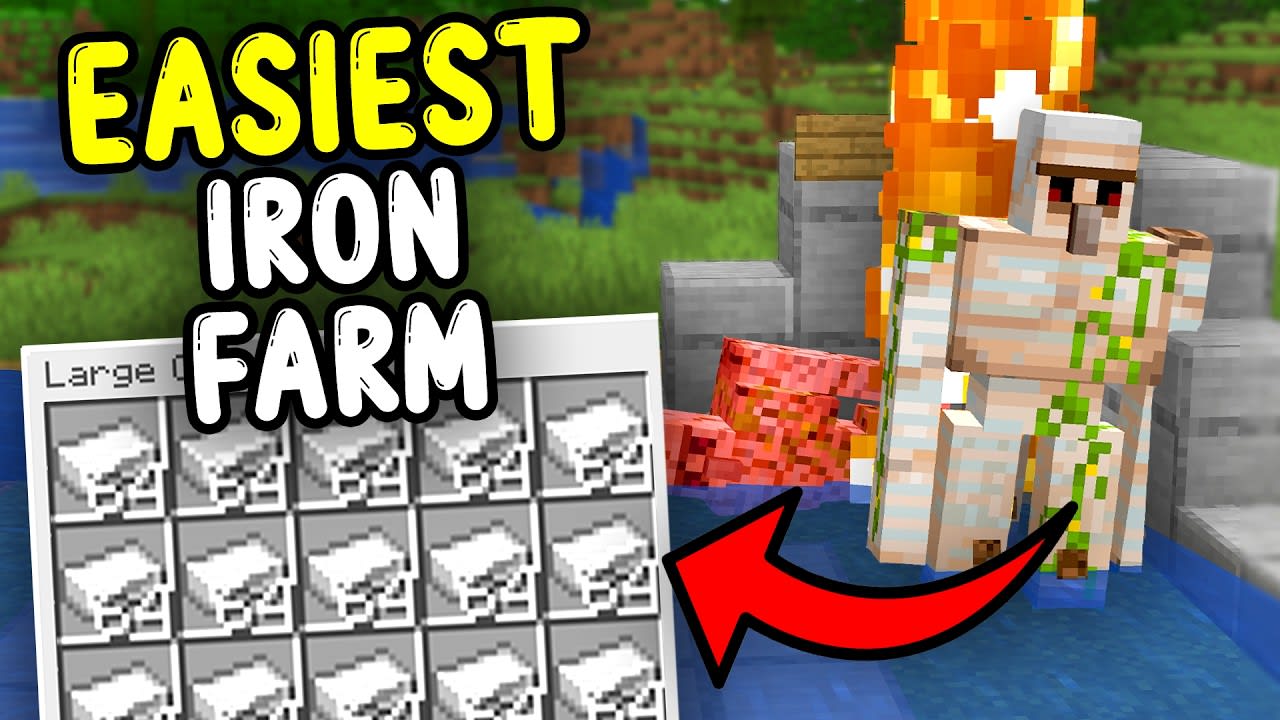
An iron farm tricks the game into thinking a village is under constant threat. Panicking villagers trigger golem spawns. Those golems fall into a kill chamber and drop 3–5 ingots each. You collect the drops, repeat forever. That's it — the whole trick in two sentences.
2. What's Actually Happening in the Game
Most build guides just tell you where to place blocks without explaining why, which is fine until something breaks and you have no idea where to even start looking. Spend two minutes here and the whole farm becomes a lot less mysterious.
Villages are not structures, they're a calculation
Minecraft doesn't track a "village" as a fixed thing the way it tracks a stronghold or a dungeon. Instead, the game dynamically constructs what's called a "potential village" every game tick by scanning for villagers who have successfully claimed a bed. If enough of those villagers detect a threat nearby — a zombie, a pillager, a player ringing a bell — the game checks whether it should spawn a protective Iron Golem.
The exact threshold is: at least
ceil(villager_count × 0.1) villagers need to be in a
panic state simultaneously. So with 3 villagers, just 1 needs to be
panicking. With 10, you need 1 as well (10% rounds up to 1). With 30
villagers, you need 3 active panics at the same time. That's why
small, simple farms with 3 villagers work so reliably — the bar for
triggering a spawn is just one scared villager.
A villager is only "in" your village if it has claimed a bed. No bed claim = the villager doesn't count toward anything. You'll see green particles when a villager successfully links to one.
A zombie visible through glass — but unable to reach the villagers — puts them in a permanent low-level panic. The glass lets the villagers "see" the threat without actually being in danger.
The game checks golem spawn conditions every 700 ticks (35 real-world seconds). If the conditions pass, a golem spawns. Miss the check window and you wait another 35s. There's no way to speed this up on a single cell.
Golems spawn within 16 blocks of the village "center," which the game calculates as the average position of all claimed beds. Cluster your beds tightly and the golems land predictably right above your kill pit.
Why farms randomly stop producing
Nine times out of ten, when a farm goes quiet, it's one of three things: the zombie despawned (because it was never named or a patch reset the NBT data), a villager died overnight and the bed count dropped below minimum, or there's a stray wild golem wandering nearby that counts against the spawn cap. The cap check happens before every spawn attempt — if even one extra golem exists in range, the game skips the spawn entirely until that golem is dead or moves out of range. We'll get into all the specific fixes in Section 7.
3. What You Need
This is for the starter single-cell version. Nothing on this list requires diamond tools or advanced exploration — you can realistically pull all of this together within the first few in-game days if you're prioritizing it. The one thing people consistently underestimate is the name tag. Get that sorted before anything else.
| Item | How Many | What It Does | How to Get It |
|---|---|---|---|
| Beds | 3 | Villagers claim these — no bed, no village, no golems | 3 wool + 3 planks each, any color |
| Villagers | 3 | The whole farm revolves around them panicking | Transport from the nearest village, or cure zombie villagers |
| Zombie | 1 | The permanent panic trigger — lives in a glass box | Trap one at night, immediately apply name tag |
| Name Tag | 1 | Prevents the zombie from despawning when you leave | Fishing (most reliable), trading with a librarian, dungeon chests |
| Glass / Glass Panes | 32+ | Zombie containment — must be see-through | Smelt sand in a furnace |
| Stone or Cobblestone | 128+ | Structure walls, platform, kill shaft | Mine literally anywhere |
| Lava Buckets | 2 | Kill chamber — golems walk into it | Any lava pool, or the Nether |
| Hoppers | 4–6 | Sucks up the ingot drops automatically | Craft: 5 iron + 1 chest each |
| Chests | 2 | Stores your ingots | 8 planks, make a double chest |
| Water Bucket | 1 | Pushes golems off the platform into the kill shaft | Right-click any water source |
| Trapdoors | 6 | Trick villagers into walking onto beds | 6 planks each |
| Torches / Lanterns | Lots | Light up the area so nothing hostile spawns nearby | Sticks + coal/charcoal |
The name tag problem. This trips up more first-time builders than anything else. If your zombie isn't named, it despawns the moment you move 128+ blocks away. Your farm silently stops working and you might not notice for hours. Go fishing first — enchanted rod, roughly 20–30 minutes, and you'll almost certainly reel one in. Worth doing before you build anything else.
4. Building the Farm
The design below is flat, readable, and easy to troubleshoot — which matters a lot when you're figuring out why something isn't working at 1am. Build it well away from any existing village on whatever Y-level makes sense for your base. The footprint is roughly 16×16 blocks total.
Pick your spot and build a raised platform about 6–8 blocks off the ground. The height matters because golems need clearance to fall down into the kill pit below. On top of the platform, make a small enclosed room — roughly 5 blocks wide, 3 blocks deep, 3 blocks tall. This is where your three villagers will sleep. Place the three beds inside, making sure each one has a clear headspace of at least 2 blocks. Leave the entrance open for now so you can wrangle the villagers in.
Getting villagers up a raised platform is the part nobody talks about. The easiest method: build a temporary ramp, push them up with a boat, or use a mine cart. Once they're inside the room, seal the entrance with trapdoors (open position, so the villagers can path-find onto the beds but can't walk back out). Now just wait. During the next in-game dusk, watch for each villager to walk toward a bed and lie down. When a bed link happens, you'll see brief green sparkle particles. You need all three linked before the farm will work properly — if one villager isn't sleeping, it's not linked.
Directly adjacent to the villager room wall, build a small glass cage: 2 blocks wide, 3 blocks tall, fully sealed on all sides including the top. Important — the glass wall that faces the villagers must be a full glass block, not a pane (panes can leave line-of-sight gaps that sometimes break detection). Bring your zombie up and seal it inside. The zombie needs to be close enough for the villagers to see it through the glass, but there cannot be any gap it could pathfind through. Once it's in, apply the name tag through the glass by sneaking and right-clicking. You should immediately see the villagers twitch and give small panic indicators — that's the system working.
Directly beneath the villager platform, carve out a drop shaft that is at least 5×5 blocks wide and 4–5 blocks deep. The reason it needs to be wide is that Iron Golems are 1.4 blocks wide and 2.9 blocks tall — they're surprisingly big, and if your shaft is too narrow, newly spawned golems get stuck on the lip of the platform instead of falling cleanly. Make the walls of the shaft solid. At the very bottom, leave a 1-block-deep ledge around the edges — this is where the lava goes.
On the villager platform, place a water source block at the back wall so the current flows toward the open drop side. You want the entire surface of the platform to be covered by the flow so that wherever a golem spawns, it gets nudged toward the edge and falls in. If your platform is wider than the water can cover in one stream, use two source blocks at opposite back corners. Test it by throwing a block of gravel — watch it slide toward the drop. If it goes where you want, the golems will too.
At the bottom of the drop shaft, place lava source blocks on the side walls of the ledge — not on the floor. The golem falls in, the lava on the walls does full damage, and the item drops land on the solid floor below the lava level where the hoppers can reach them. If you put lava on the floor, drops land in the lava and get destroyed before hoppers collect them — a mistake that's painful to discover on your first test run. Two lava source blocks on opposite walls is usually enough to kill a golem in under 3 seconds.
Cover the entire floor of the kill chamber with hoppers, each one pointing toward the next in a chain, ending at a double chest either beside or below the chamber. Shift-click to connect them — crouch and right-click one hopper onto the side of the next. To test it: manually throw a handful of iron ingots on the kill floor and watch them get sucked into the chest. If even one ingot stays on the floor for more than a second, you have a gap in hopper coverage. Fill it.
Torch or slab every dark surface within about 64 blocks of the farm. Hostile mobs that spawn nearby count against the local mob cap and can interfere with golem spawning rates indirectly. With everything lit and the zombie triggering panic, your first golem should appear on the platform within 1–2 in-game nights. Watch it follow the water, fall into the shaft, hit the lava, and see the ingots pull into the chest. If that works, you're done with the core build.
5. Getting the Drops Out Reliably
The hopper chain is simple but it has a few failure modes people run into. The biggest is hopper direction — every hopper points toward the next one in the chain, and the last one must point directly into the chest. If you accidentally placed one facing the wrong way, items pile up at that point and nothing gets through. Break and replace any hopper that looks misaligned.
What about poppies filling up your storage?
Iron Golems drop between 0 and 2 poppies every kill. On a fast farm, that's a meaningful volume of flowers going into your chest alongside the ingots. If you don't care, just empty the chest occasionally. If you want to separate them automatically, a basic item filter works: put a chest with a named filler item and one poppy slot next to a hopper-minecart track — it'll pull poppies into one chest and let iron ingots pass through to another. Completely optional for a single-cell farm. Worth doing once you've scaled up to five or more cells.
The hopper lag thing. On large farms with 20+ cells, active hoppers checking every tick can cause minor TPS drops. The fix is a hopper-minecart running over detector rails to move items in bulk — this is purely an optimization for massive farms and you won't notice it at all on anything under 8 cells. Don't overthink it at the start.
6. Output Rates — and How to Scale
Let's be upfront about what a single cell actually produces. One golem every 35–40 seconds, 3–5 ingots per golem — that averages out to around 120–150 ingots per hour in real-world testing with normal AFK conditions. That's decent, but it won't keep up with a heavy technical playthrough. The good news is scaling is completely linear — you just build more identical cells.
The critical rule for multi-cell farms: each cell must be at least 64 blocks away from every other cell's center. The "center" is the average coordinate of all the beds in that cell. Get the cells too close and the game merges them into a single village — you get combined population but not doubled golem output. That's a painful thing to discover after you've built six cells in a neat row that's too compact.
The farm only runs when its chunks are loaded. On Java, the default sim distance is 10 chunks. On Bedrock it varies. If you AFK somewhere else on your base and it's more than 160 blocks away, the farm goes completely idle. Build a dedicated AFK platform directly above the farm at around Y=250 — stand there, load a YouTube video, come back to a full chest.
If your zombie cell has any exposure to sunlight through the top, the zombie burns up and your farm stops panicking. Always roof the cage with solid blocks, not glass. The villagers don't need to see the sky — they just need to see the zombie. A fully enclosed cage with a solid roof is actually better because the zombie survives indefinitely without any daylight concern.
Mobs spawning in caves and dark areas within 128 blocks of your farm compete for the local mob cap. On paper this shouldn't affect golem spawns since golems aren't counted by the hostile mob cap — but in practice, crowded chunk loading in a mob-heavy area causes tick delays that slow the whole farm down. Slab, carpet, or torch anything dark within range.
7. When It Breaks — Real Fixes for Real Problems
Something stopped working. Maybe it was fine for a week and now it's producing nothing. Here's what to actually check, in order of how common each problem is.
No golems spawning at all
Start with the zombie. Is it still there? Walk up to the cage and look in. If it's gone, that's almost certainly your problem — the name tag either wasn't applied, got reset by a game update, or the zombie was somehow killed through the glass. Get a new zombie and name it before putting it in the cage this time. If the zombie is still there, check each villager. Stand nearby at dusk and watch — are all three walking to a bed and sleeping? A villager that just stands still overnight has lost its bed link. Break and replace its bed to force a new claim. Finally, look around within about 100 blocks for any stray Iron Golems that spawned from a wild village. Kill them — until they're gone, your farm's spawn cap is blocked.
Golems spawning but ending up outside the kill zone
This is a bed positioning issue. The game calculates the village center from the average of all bed head positions, then tries to spawn the golem within 16 blocks of that point. If your beds are spread out loosely, the center shifts and golems start landing on the platform edges, or worse, outside it entirely. Bunch your beds into a tighter cluster and it should pull the spawns back over the drop shaft. You can also block off parts of the platform with carpets or slabs (they prevent golem spawning on that surface) to funnel spawns toward the opening.
Easy debug check. If you're not sure whether a villager has claimed a bed, throw a splash potion of night vision on yourself and look at their nameplate color in the dark. More usefully — feed a villager some bread and watch if they display green "happy" particles during the day. That usually confirms they're successfully linked to a nearby bed and counting toward golem spawns.
Ingots disappearing before reaching the chest
Lava placement. If you put lava on the floor of the kill chamber rather than on the side walls, drops land in it and burn instantly. Move the lava to the side walls only — place it one block up from the floor. The golem still takes fatal damage but the ingots fall onto the dry floor where the hoppers can collect them. Also double-check that you don't have an accidental gap between hoppers — a single-block gap lets items fall through and despawn.
Villagers keep dying
Something is getting to them at night. Usually it's a zombie that found a way in — check the walls of the villager room for any 1×2 gaps. Zombies path-find aggressively toward villagers and will squeeze through anything they can reach. Seal every gap with solid blocks or trap doors. Also check that your platform isn't so close to the ground that zombies can jump up onto it. A clean 6-block drop on all sides is usually enough to keep them out.
Farm worked perfectly, then suddenly stopped after a game update
Updates occasionally change mob entity data, which can silently clear a zombie's name tag NBT. After any significant update, go check the zombie is still named. On Bedrock specifically this has been a recurring issue across multiple versions. Some players keep a spare name tag in a chest right next to the farm for exactly this reason.
8. Going Further
Once the single cell is humming along and you're comfortable with how it works, here's where most players go next.
Multi-cell arrays — the standard upgrade
Build 8–12 identical cells in a row or staggered grid, each at least 64 blocks center-to-center. Run all kill chambers into a single hopper highway leading to one central storage room. Suddenly you're pulling 1,200–1,800 ingots per hour without doing anything fundamentally different. The resource cost upfront is mostly iron for the hoppers — which is a bit of a chicken-and-egg problem — so either trade with villagers for early iron or do one focused mining session before building the array.
Stacked vertical designs
If you're on a Sky Block or island world where horizontal space is tight, you can stack cells vertically. The mechanics don't care which axis you separate them on — 64 blocks vertical separation works the same as horizontal. The trade-off is that troubleshooting vertical designs is genuinely harder. Debugging bed links and zombie sight lines across multiple floors is annoying. Stick to horizontal arrays until you're comfortable, then experiment vertically if space actually demands it.
Bedrock-specific tweak
On Bedrock, iron farm output can be noticeably lower than Java with an identical design because the panic detection range and tick rate behave differently. The most common fix is bumping villager count from 3 to 5 per cell. More villagers means the panic threshold (1 in 10) is hit more consistently per cycle, which increases real-world golem production even though the spawn timer itself doesn't change. It's a small extra cost that adds up across a 12-cell array.
Trading post combo. Since you already have 3+ villagers at the farm, you might as well assign them useful professions while you're at it. A lectern makes a librarian. A smithing table makes a toolsmith. Drop a few job site blocks inside the housing room and start building up your trades — a fully leveled toolsmith will give you iron tools for emeralds, which is useful in the early game before the farm is producing at full speed.
9. Questions People Actually Ask
Does it work in the Nether or End?
Mechanically yes — the golem spawn logic doesn't care what dimension it's in. The challenge is just getting villagers there, which involves a lot of careful boating and portal management. There's no real benefit to building in the Nether or End over the Overworld unless you have a specific reason for it. If you're doing a Sky Block or custom map that forces you there, it works fine.
Do I need to be AFK right at the farm?
Not at the farm exactly, but within simulation distance of it — typically around 128–160 blocks depending on your settings. A lot of players build a small platform or room directly above the farm at a high Y-level, grab a book, and just sit there while it runs. Some server setups let you use carpet mod or similar tools to chunk-load specific areas without being present, but in vanilla singleplayer you need to be nearby.
How long to fill a double chest on a single cell?
A double chest holds 3,456 ingots. At 130 ingots per hour on a single cell, you're looking at roughly 26 hours to fill it completely. On a 12-cell farm running at 1,600/hr, that's barely 2 hours. That's why the first upgrade people make is almost always "build more cells" — the time investment per cell is small and the return is direct and linear.
Can villagers breed inside the farm and mess things up?
They'll try if there are unclaimed beds and they've been fed recently. In a 3-bed, 3-villager setup, any new baby that grows up and claims a bed would just become a 4th contributing villager — which actually slightly helps your output. The problem is if the population grows uncontrolled and villagers start trying to path-find to new beds outside the room, getting stuck on the walls or escaping. Just don't leave loose food items in the farm area and it's rarely an issue.
Can I build this next to my main base?
Only if your main base is at least 150 blocks from any natural village that existed before you started building. The danger isn't aesthetic — it's that nearby villages bleed into the same detection radius and compete for golem spawn caps. Most players either build the farm far enough away that it's a short run, or set up a Nether highway to reach it instantly. The 150-block rule is the thing that catches people off guard most often.
Will manually-built golems (the iron block + pumpkin kind) mess with spawn rates?
No — player-placed golems are tagged as "player-created" in their entity data and don't count toward the natural village golem cap. So your iron golem statue out front won't starve your farm. However, any golem that spawned naturally from a nearby wild village and wandered into range of your farm will count against the cap. Kill those on sight.
10. Best Seeds for Iron Farming
These tested seeds from our library feature villages near spawn, which reduces villager transport time when you build an iron farm nearby:
- Double Village Spawn — Two villages at spawn with plenty of villagers to transport to your farm.
- Quad Village Blossom Plateau — Four villages clustered near spawn for maximum villager access.
- Cherry Valley Village — A scenic valley village with flat terrain ideal for farm placement.
- Floating Village — A village with elevated terrain, natural height advantage for iron farm builds.
Browse our full seed library or check our village seeds collection for more options.
NEED A WORLD TO PUT IT IN?
Now that you know how to generate unlimited iron, you need a seed with flat terrain near a village — ideal for setting up your first cell without a ton of terraforming. Use the Minesite Seed Map to scout the perfect location before you even open the game. And while you're at it, give your character a fresh look with the free Skin Editor — runs entirely in your browser, no downloads.