
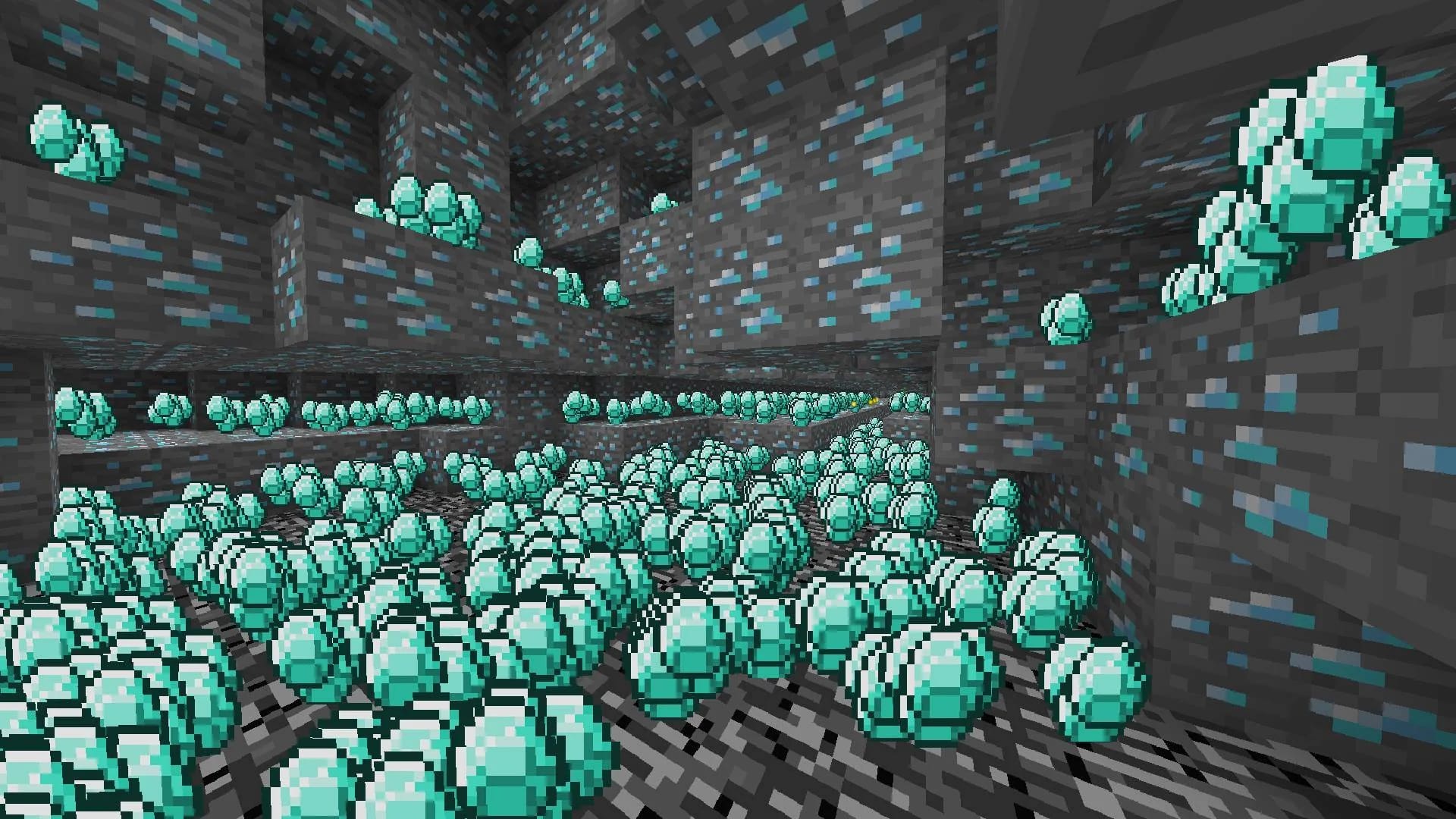
1. The Best Y-Level (-59)
If you're still mining at Y=11 or Y=12, you are using outdated information from before the Caves & Cliffs update. The world height has changed, and so has diamond generation. If you are returning after older mining guides, the important change is simple: diamond ore is now strongest near the bottom of the Overworld, and air exposure makes visible veins less reliable.
In 2026, the absolute best Y-level to mine for diamonds is Y= -59. Diamond ore generation increases the deeper you go, peaking right above the bedrock layer which starts at Y= -60. The mathematics of world generation mean that diamonds are distributed in a triangular pattern—meaning the lower you are on the Y-axis, the higher the concentration of diamond blobs.
While diamonds do generate down to Y= -64, going below -59 exposes you to uneven bedrock blocks that will ruin your mining efficiency. By staying at Y= -59, you keep your feet exactly one block above the bedrock layer while maximizing your exposure to the highest possible density of diamond spawns.
Many players wonder if it's worth mining higher up (like around Y= -54 or -53) to avoid the massive lava lakes that generate near the bottom of the world. While this strategy does keep you slightly safer from sudden lava bursts, it fundamentally reduces your hourly diamond yield. The difference in ore generation between Y= -54 and Y= -59 is mathematically significant. If your primary goal is maximizing your diamond count, you must stay as low as possible and learn to manage the lava effectively.
2. Branch Mining (Strip Mining) Strategies
Branch mining — sometimes wrongly called strip mining — is the method most experienced players default to for a simple reason: it is controllable. You are not reacting to mob ambushes or navigating unpredictable cave geometry. You dig in a straight line, you expose ore as you go, and you see exactly how many diamonds you are getting per hour. The results are consistent enough to plan around.
Always use a staircase or water bucket drop to get down safely. Never dig straight down. Digging straight down (the number one rule of Minecraft) is a surefire way to end up falling into a lava lake or a massive cavern.
Mine a main tunnel straight ahead. This will be your central highway. A 2x2 tunnel is easier to sprint down, while a 2x1 is faster to dig initially.
Leave exactly two solid blocks between each of your side branches. This guarantees you will see any diamond vein hidden in the walls without mining unnecessary blocks. For maximum efficiency, many players now use the "Poke-Hole" method: dig your main tunnel, and just mine 1x1 holes into the walls as far as you can reach (about 5 blocks deep) every 3 blocks.
The Trapdoor Crawl Method
If you want to achieve the absolute maximum blocks-revealed-per-durability-spent, the 1x1 crawl method is the most efficient technique in 2026. By placing a trapdoor on the bottom half of a block in front of you, opening it, standing inside its block space, and closing it on yourself, your character will be forced into the swimming/crawling animation. You can then mine a 1x1 tunnel for hundreds of blocks.
This method reveals 4 blocks for every 1 block mined, compared to a 2x1 tunnel which reveals 6 blocks for every 2 blocks mined (a 3:1 ratio). It preserves your pickaxe durability and massively increases your diamond discovery rate. Just be warned: if you encounter gravel or a sudden lava pocket in a 1x1 tunnel, your escape options are severely limited. Always keep a water bucket in your hotbar.
Promote Your Playstyle: Planning a massive branch mine? Use our Seed Map Planner to check what biomes you are mining under. Mining under Swamp biomes might expose you to more slimes, while mining under Mountains can yield Emeralds alongside your Diamonds!
3. Caving vs. Mining in Deepslate
For players who prefer action over the repetitive grind of branch mining, exploring deep caves and ravines below Y=0 is a fantastic way to find diamonds. Thanks to the massive cave generation updates, exposed diamond veins are very common in deepslate caves. However, caving introduces a whole new set of risks and rewards.
The Risk of the Deep Dark
When caving below Y= -20, you run a high risk of encountering the Deep Dark biome and its terrifying resident: the Warden. The Warden hits incredibly hard, applies darkness effects, and can track you by sound. If you are caving for diamonds and see sculk blocks (the dark, starry blocks that grow in the Deep Dark), proceed with extreme caution or turn back entirely if you are under-geared.
Conversely, Ancient Cities (which generate in the Deep Dark) contain chests with high-tier loot, but rarely raw diamond ore. Your goal when caving for diamonds is to find massive, open water caves or sprawling dripstone networks at the bottom of the world, avoiding the Deep Dark if possible.
Pro Tip: When exploring caves, check the ceilings! Many players only look at the floor and walls, but diamonds frequently spawn on the underside of overhangs. Furthermore, check the edges of lava lakes carefully. Diamonds often generate right at the lava line, requiring you to carefully place water to mine them safely without dropping the items into the fire.
4. The Fortune Enchantment
Finding diamonds is only half the battle. To truly get rich, you need the Fortune III enchantment on your pickaxe. This is non-negotiable for serious players in 2026.
Without Fortune, one diamond ore drops exactly one diamond. With Fortune III, a single ore block can drop up to four diamonds, averaging around 2.2 diamonds per ore across large sample sizes. If you find a vein of diamonds early on before you have an enchanting setup, it is highly recommended to mark the coordinates (press F3 on Java Edition, or enable 'Show Coordinates' on Bedrock) and leave them unmined until you can return with a Fortune pickaxe.
How to Get Fortune III Fast
Relying on the Enchanting Table is highly random and can waste dozens of levels. The most reliable way to get Fortune III in 2026 is through Villager Trading. By capturing a Librarian villager and repeatedly breaking and placing their Lectern workstation (before trading with them for the first time), you can reset their trades until they offer a Fortune III enchanted book.
This method guarantees you can buy as many Fortune III books as you need, ensuring that if you lose your pickaxe in lava, you aren't starting from scratch.
5. Common Mistakes to Avoid
You must use an Iron Pickaxe, Diamond Pickaxe, or Netherite Pickaxe to mine diamond ore. If you use stone, wood, or gold, the block will break but drop absolutely nothing. It is a heartbreaking mistake that every player makes exactly once.
Lava lakes are incredibly common at Y= -54 and below. If you hear popping sounds, slow down and have blocks ready in your off-hand to plug any leaks. A sudden burst of lava can end your mining trip permanently.
Diamond veins generate diagonally and can snake behind other blocks! Once you find a diamond, mine all the blocks touching it (including the corners) to make sure you didn't miss any hidden ores buried just one block deep.
Even in the deepslate layer, hostile mobs will spawn in unlit areas. Branch mining in the dark is a recipe for a Creeper sneaking up behind you. Always light your tunnels.
Never go deep caving without a way back. Always place torches on the right side of the wall as you explore; that way, you know you are heading home when the torches are on your left. Better yet, write down your base coordinates.
6. Looting Structures for Diamonds
If mining isn't your style, you can acquire significant amounts of diamonds by looting generated structures. While not as consistent as branch mining with Fortune III, structure looting can provide a massive boost to your early game.
- End Cities: The chests in End Cities have an incredibly high chance of containing diamonds and diamond gear.
- Buried Treasure: Often found near coastlines, these chests frequently contain diamonds, emeralds, and heart of the sea.
- Bastion Remnants: The treasure room in a Bastion (guarded by Piglin Brutes) is extremely dangerous but often yields blocks of diamonds and ancient debris.
- Trial Chambers: Introduced in recent updates, these underground structures offer vault rewards that can occasionally drop diamonds.
Finding these structures manually can take hours. Save time by using the Minesite Seed Map Planner. Just enter your world seed, toggle the specific structures you want to find, and get the exact coordinates instantly.
6.5 Multiplayer Diamond Strategies
Finding diamonds on a multiplayer server, especially one that has been active for several weeks or months, presents a unique challenge. Because all the chunks within thousands of blocks of the world spawn have likely already been completely stripped of their resources by other players, you cannot simply dig down at your starter base and expect to find full diamond veins.
The Nether Hub Commute
To find pristine, unmined chunks on a populated server, you must utilize the Nether. Every 1 block traveled in the Nether equals 8 blocks traveled in the Overworld. Build a portal, travel safely along the Nether roof or through a constructed ice-boat highway in the Nether hub, and travel at least 500 blocks away from the center. When you build a new portal and enter the Overworld, you will be 4,000 blocks away from spawn. At this distance, the deepslate layer will be completely untouched, allowing you to establish a fresh branch mine.
Bypassing Mining Entirely: The Armor, Tool, and Weapon Smiths
Interestingly, the most efficient way to acquire full diamond gear on a multiplayer server often involves zero mining. By setting up a villager trading hall, you can completely bypass the diamond economy.
Armorer villagers, Toolsmiths, and Weaponsmiths can all be leveled up to their Master tier. At the Master tier, Armorers will consistently sell full sets of Diamond Armor (helmet, chestplate, leggings, and boots) in exchange for Emeralds. Similarly, Toolsmiths will sell Diamond Pickaxes, Axes, Shovels, and Hoes, while Weaponsmiths sell Diamond Swords. These items even come pre-enchanted, though the enchantments are random and usually require an anvil to perfect.
By building a massive farm (such as an iron farm, pumpkin/melon farm, or raid farm) to generate infinite emeralds, you can simply purchase all the diamond gear you will ever need. You can then use your emeralds to buy Mending books from Librarians and never have to worry about your diamond gear breaking. Save the raw diamonds you do mine exclusively for crafting enchanting tables, jukeboxes, or duplicating armor trims.
7. Frequently Asked Questions
Do diamonds spawn more in certain biomes?
No. Diamond ore generation is tied to the Y-level, not the biome. Desert, jungle, ocean, and plains terrain use the same diamond density rules at Y= -59. The only exception is the fossil structure (which rarely contains diamond ore) and the fact that deep dark biomes have less standard stone to break, but the base ore generation math is uniform across the Overworld.
Can I find diamonds above Y=0?
Very rarely. Diamond ore technically begins generating in extremely small quantities around Y=15, but the odds of finding them there are astronomically low. It is never worth your time to actively search for diamonds above Y=0. Always head down to the deepslate layer.
What is the most diamonds you can get from one ore?
Without enchantments, you get 1 diamond per ore. With Fortune I, you can get up to 2. With Fortune II, up to 3. And with Fortune III, you have a 20% chance to multiply the drop by 4, meaning the absolute maximum is 4 diamonds from a single block of diamond ore.
Is TNT mining viable for diamonds?
Yes, but with caveats. TNT destroys 100% of the blocks in its blast radius but guarantees 100% drop rates for the items it destroys. However, you cannot apply the Fortune enchantment to TNT blasts. Therefore, while TNT mining clears massive amounts of deepslate quickly, you will only ever get 1 diamond per ore block, making it less efficient per-vein than branch mining with a Fortune III pickaxe.
How do I check my Y-Level?
On Java Edition, press the F3 key on your keyboard to open the debug screen; your coordinates (XYZ) are listed on the left side, with the middle number being your Y-level. On Bedrock Edition, pause the game, go to Settings > Game, and toggle on 'Show Coordinates'. The coordinates will permanently display in the top left corner of your screen.
8. Best Seeds for Diamond Mining
These tested seeds from our library feature excellent underground generation, exposed caves, and structures with diamond loot:
- Huge Lush Cave — Massive lush cave system with exposed ore veins at diamond levels.
- Frozen Crater Lake with Lush Cave — Deep crater leads directly to diamond-rich deepslate caves.
- Incredible Hollow Mountain — Hollow mountain with natural cave access to the deepslate layer.
- Double Village Spawn — Multiple villages for early Fortune III from Librarian villagers.
Browse our full seed library for 30+ seeds with screenshots, coordinates, and seed planner links.
READY TO MINE?
Use our interactive Seed Map Planner to find the best cave systems, Trial Chambers, and Bastion Remnants instantly. Need a fresh start? Check out our Best Seeds of 2026 to find a world with perfect underground generation.